
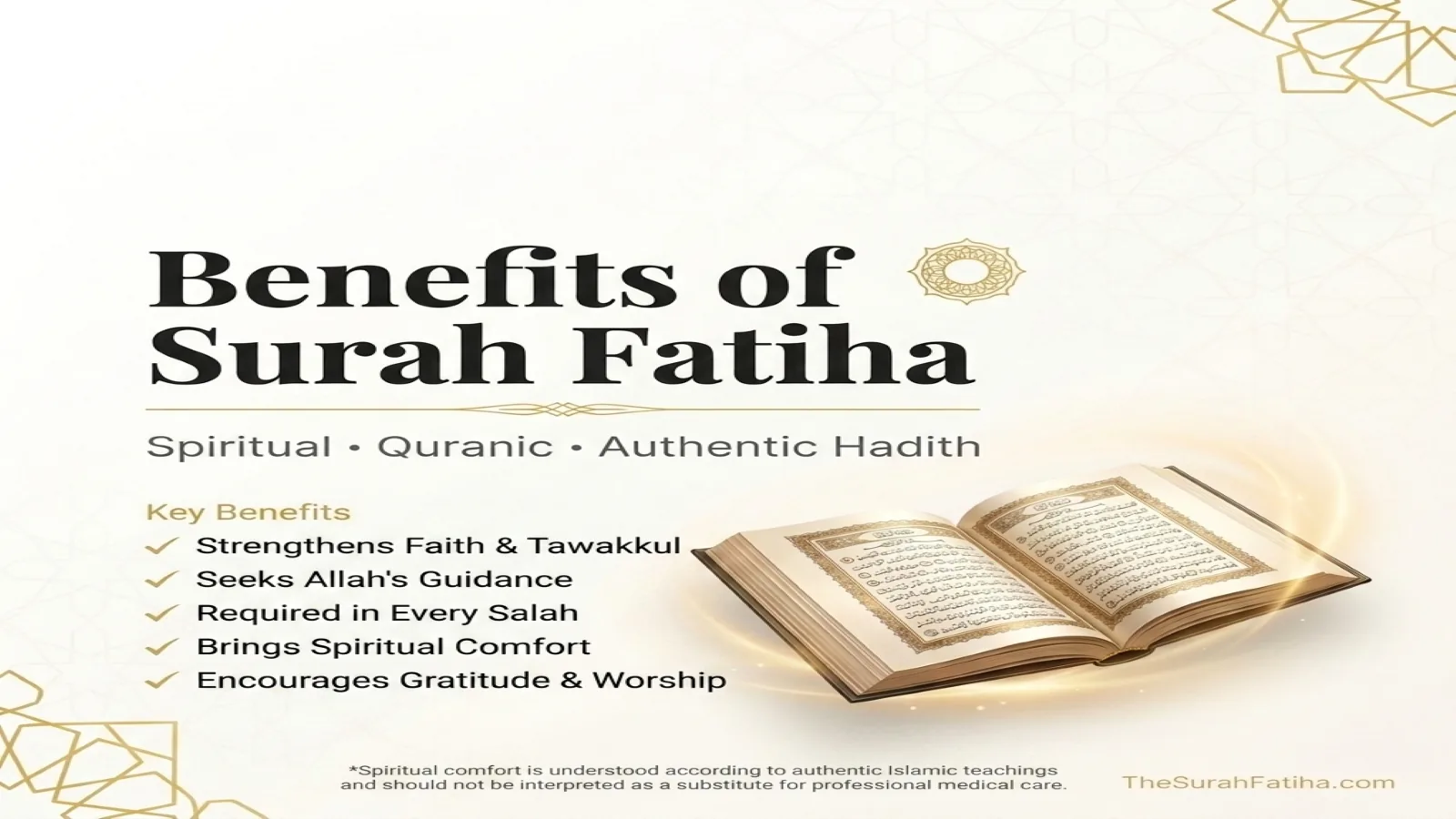
Benefits of Surah Fatiha
Introduction
Surah Al-Fatiha is the shortest surah a Muslim recites most often, and yet its benefits are among the most widely discussed in Islamic literature — and, unfortunately, among the most exaggerated on the internet. Surah Al-Fatiha is also commonly transliterated as Surah Al-Fatihah, and it is the opening chapter (Chapter 1) of the Holy Quran. It is generally classified as a Makki surah consisting of seven verses. This page separates what the Quran itself says about this surah, what is recorded in authentic Hadith, and what has simply become popular belief without solid evidence. That distinction matters, because Islam asks believers to base their faith on sound sources rather than assumption.
Whether you are reciting Surah Al-Fatiha in Salah five times a day or reading it slowly for reflection, understanding its real, evidence-based benefits deepens both your worship and your appreciation of the Holy Quran. For the full Arabic text alongside English, Roman English, Hindi and Urdu translations, visit our homepage.
Why Surah Al-Fatiha Is Called the Greatest Surah
Authentic HadithThe companion Abu Sa’id ibn al-Mu’alla narrated that the Prophet Muhammad ﷺ called him while he was praying, and afterwards told him he would teach him the greatest surah in the Quran before they left the mosque. The Prophet ﷺ then identified it as Al-Hamdu lillahi Rabbil ‘Alamin (Quran 1:2) — Surah Al-Fatiha — describing it as the Seven Oft-Repeated Verses (As-Sab’ al-Mathani) and the Grand Quran given to him. This narration is recorded in Sahih al-Bukhari.
Scholars of tafsir point out that this status is not simply about length or wording. Surah Al-Fatiha contains, in seven ayahs, the core relationship between a servant and Allah: praise, lordship, worship, dependence, and the request for guidance. That density of meaning is part of why classical commentators including Ibn Kathir and Al-Sa’di explain that Surah Al-Fatiha encapsulates the central themes of the Quran.
Spiritual Benefits of Surah Fatiha
Supported by the Quran’s structureRead slowly, Surah Al-Fatiha moves through a clear spiritual sequence. It begins with gratitude — Alhamdulillahi Rabbil Alamin — before a single request is made. Only after acknowledging Allah as Lord of all worlds does the surah turn to worship and, finally, to supplication. That order teaches a pattern that Islamic scholars encourage believers to apply in their own du’a: praise first, then commitment, then asking.
The line Iyyaka na’budu wa iyyaka nasta’in (Quran 1:5) — it is You alone we worship and You alone we ask for help — is often cited as one of the clearest expressions of Tawheed in the Quran. It rules out reliance on anything or anyone besides Allah, while also affirming that worship without sincerity is incomplete.
Surah Al-Fatiha is the only surah recited in full during every single rak’ah of Salah — obligatory and voluntary — making it the most frequently repeated passage in the Holy Quran.
Benefits in Daily Prayer
Authentic HadithThe Prophet ﷺ said, “There is no prayer for the one who does not recite the Opening of the Book [Al-Fatiha]” — a narration agreed upon in Sahih al-Bukhari and Sahih Muslim. Because of this, the majority of scholars across Sunni schools of thought treat reciting Al-Fatiha as a pillar (rukn) of Salah, not a recommended addition.
A separate hadith Qudsi in Sahih Muslim describes Salah as a conversation: when the servant says Alhamdulillahi Rabbil Alamin, Allah responds that His servant has praised Him; when the servant reaches Iyyaka na’budu wa iyyaka nasta’in, Allah says this ayah is shared between Him and His servant; and when the servant asks to be guided to the straight path, Allah says this is for His servant, and grants what he has asked. This narration is one reason scholars describe Al-Fatiha as a direct dialogue between the worshipper and Allah, repeated in every prayer.
Benefits for Reflection
Beyond its role in Salah, Surah Al-Fatiha rewards slow, deliberate reading outside of prayer. Because it moves from praise, to worship, to guidance, reciters often describe it as a mirror of a believer’s entire life journey — gratitude for what Allah has given, commitment to worship Him alone, and an ongoing need for direction.
The final ayah (Quran 1:7) — asking to be kept on the path of those who received favour, rather than those who earned anger or went astray — encourages regular self-examination. It is a request repeated at least seventeen times a day through the five daily prayers, which is why numerous classical scholars encourage reflecting on its meaning rather than reciting it purely by habit.
Benefits Mentioned in Authentic Hadith
Authentic HadithSeveral benefits of Surah Al-Fatiha come directly from Hadith literature rather than the Quran’s text itself. The clearest examples include:
- Its unmatched status: described by the Prophet ﷺ as the greatest surah in the Quran (Sahih al-Bukhari).
- Its role as a direct exchange with Allah during Salah, as described in the hadith Qudsi recorded in Sahih Muslim.
- Its use in ruqyah (spiritual healing through recitation), recorded in Sahih al-Bukhari, discussed in detail below.
These are distinct from claims that circulate informally — for example, specific repetition counts said to guarantee wealth, marriage, or protection from evil eye — which are not found in Sahih al-Bukhari, Sahih Muslim, or the other major Hadith collections.
The Healing (Ash-Shifa) Aspect
Authentic HadithSurah Al-Fatiha is sometimes referred to as Ash-Shifa — the Healer — because of a well-known narration in Sahih al-Bukhari. A group of companions were travelling and stopped in a settlement whose chief had been bitten by a scorpion. One companion recited Surah Al-Fatiha over him as ruqyah, and the man recovered. When the incident was reported to the Prophet ﷺ, he confirmed that Al-Fatiha could indeed be used this way and approved the reward the companions received for it.
This narration is the primary textual basis for treating Surah Al-Fatiha as having a healing dimension. Scholars are careful to note that this refers to spiritual and permissible ruqyah — recitation performed with sincere belief in Allah’s power to heal — not a substitute for medical treatment or a guaranteed cure for any specific illness.
Can Surah Fatiha Be Recited for Healing?
Yes, reciting Surah Al-Fatiha as ruqyah is permissible and has a basis in authentic Hadith, as outlined above. The Prophet ﷺ said there is no harm in ruqyah as long as it does not involve shirk (association of partners with Allah), a principle recorded in Sahih Muslim. Reciting Al-Fatiha over oneself, a family member, or someone who is unwell, with sincere trust in Allah, falls within this permitted practice.
Ruqyah with Surah Al-Fatiha is a spiritual practice, not a medical treatment. Illness should always be addressed with appropriate medical care alongside sincere du’a. Recitation is a means of seeking Allah’s help — it is not a promise of a specific outcome.
Importance of Understanding Its Meaning
Many Muslims memorise Surah Al-Fatiha as children and recite it thousands of times over a lifetime, often without pausing to consider each phrase individually. Scholars consistently encourage believers to study the meaning of what they recite, since khushu’ (attentiveness and humility) in Salah is closely tied to understanding the words being spoken.
Reading a reliable Quran translation alongside the Arabic — such as the Surah Fatiha in English translation on this site — is a practical first step. From there, classical tafsir works such as those of Ibn Kathir or Al-Sa’di provide deeper explanation of each ayah’s context and implications.
Lessons Every Muslim Can Learn
Gratitude comes first
Praise precedes every request. The surah models du’a that begins with thankfulness rather than immediate asking.
Worship and dependence are linked
Iyyaka na’budu wa iyyaka nasta’in teaches that sincere worship and honest reliance on Allah go together.
Guidance must be requested continually
The straight path is asked for repeatedly, not assumed to be secured once and for all.
Discernment matters
The final ayah distinguishes between sincere guidance, deliberate rejection, and wandering without knowledge — a distinction relevant to everyday decisions.
Surah Al-Fatiha is not only recited — it is meant to shape how a believer approaches gratitude, worship, and guidance every single day.
How to Include Surah Fatiha in Daily Life
- Recite it attentively in each rak’ah of Salah rather than by habit alone.
- Pause after Salah occasionally to reflect on one ayah at a time.
- Read a trusted translation to understand the meaning behind the Arabic words.
- Use it in personal du’a and, where appropriate, as ruqyah for yourself or loved ones.
- Teach children the surah alongside its basic meaning, not just correct pronunciation.
Conclusion
The genuine benefits of Surah Al-Fatiha are substantial without needing exaggeration. Its recitation is an essential pillar (rukn) of every rak’ah according to the majority of Sunni scholars, and it was described by the Prophet ﷺ as the greatest surah in the Quran, carrying a recorded basis for use in ruqyah. Approaching it with understanding — rather than relying on unverified practices — is what authentic Islamic scholarship encourages.
To continue studying this surah, explore the full Arabic text with translation on our homepage, or read it in English, Roman English, Hindi, or Urdu. You can also learn more about our approach on the About Us page, or reach out with questions or corrections through Contact Us.
Frequently Asked Questions
What are the benefits of Surah Al-Fatiha?
Its recitation is an essential pillar (rukn) of every rak’ah according to the majority of Sunni scholars, and it was described by the Prophet ﷺ as the greatest surah in the Quran (Sahih al-Bukhari). It teaches gratitude, Tawheed, and reliance on Allah, functions as a direct exchange between the worshipper and Allah during prayer (Sahih Muslim), and has a recorded basis for use in ruqyah for healing (Sahih al-Bukhari).
Can Surah Fatiha cure every illness?
No. Authentic Hadith records one incident where reciting Al-Fatiha as ruqyah helped a man recover from a scorpion sting (Sahih al-Bukhari), which is the basis for its use in spiritual healing. However, this is not a guarantee that it will cure any and every illness. Islamic teaching does not present ruqyah as a replacement for medical treatment, and no authentic source makes that claim.
What are the benefits of reading Surah Fatiha 41 times?
The practice of reciting Surah Al-Fatiha exactly 41 times for a specific outcome is commonly circulated in some communities, but it is not established by the Quran or any Sahih Hadith. Believers are encouraged to rely on authentic sources for religious practice rather than customs without a verified basis, and to seek guidance from qualified scholars when unsure.
What happens if you read Surah Fatiha 100 times?
There is no authentic Hadith attaching a specific outcome to reciting Surah Al-Fatiha exactly 100 times. What is established is that sincere, reflective recitation of the Quran carries general reward, and that Al-Fatiha in particular holds a unique status in Salah and du’a. Attaching a guaranteed result to a specific count is not supported by evidence.
Why is Surah Fatiha called Umm al-Kitab?
Umm al-Kitab, Mother of the Book, reflects that Surah Al-Fatiha summarises the central themes of the entire Quran — praise, lordship, worship, and the request for guidance — in just seven ayahs. It is also known as Umm al-Quran for the same reason.
Why is Surah Fatiha important in Salah?
The Prophet ﷺ said there is no prayer for the one who does not recite it (Sahih al-Bukhari and Sahih Muslim). Its recitation is an essential pillar (rukn) of every rak’ah according to the majority of Sunni scholars, rather than an optional addition. A hadith Qudsi in Sahih Muslim also describes it as a direct exchange between the worshipper and Allah during Salah.
What does Surah Fatiha teach us?
It teaches that gratitude should come before requests, that worship belongs to Allah alone, that believers depend entirely on Him for help, and that guidance toward the straight path must be sought continually rather than assumed.
Can Surah Fatiha be recited for dua?
Yes. Surah Al-Fatiha itself is structured as a du’a, particularly its final ayahs asking for guidance. Numerous classical scholars recommend reciting it with presence of heart both inside and outside Salah as a form of supplication.
What are the seven verses of Surah Fatiha?
Surah Al-Fatiha consists of seven verses. Scholars differ over whether Bismillah is counted as the first verse, depending on the accepted method of verse numbering. In the commonly used Hafs recitation, Bismillah is counted as the first verse, followed by the praise of Allah as Lord of the worlds, His mercy, His sovereignty over the Day of Recompense, the declaration of worship and reliance, and the request for guidance to the straight path.
Why is Surah Fatiha called Ash-Shifa?
The name Ash-Shifa, the Healer, comes from the Hadith in Sahih al-Bukhari describing a companion who recited Al-Fatiha as ruqyah over a man bitten by a scorpion, after which he recovered. The Prophet ﷺ confirmed this use was valid, which is why the surah carries this title in Islamic tradition.