
Noorani Qaida vs. Direct Quran Reading: Which Method Is Best for Beginners?
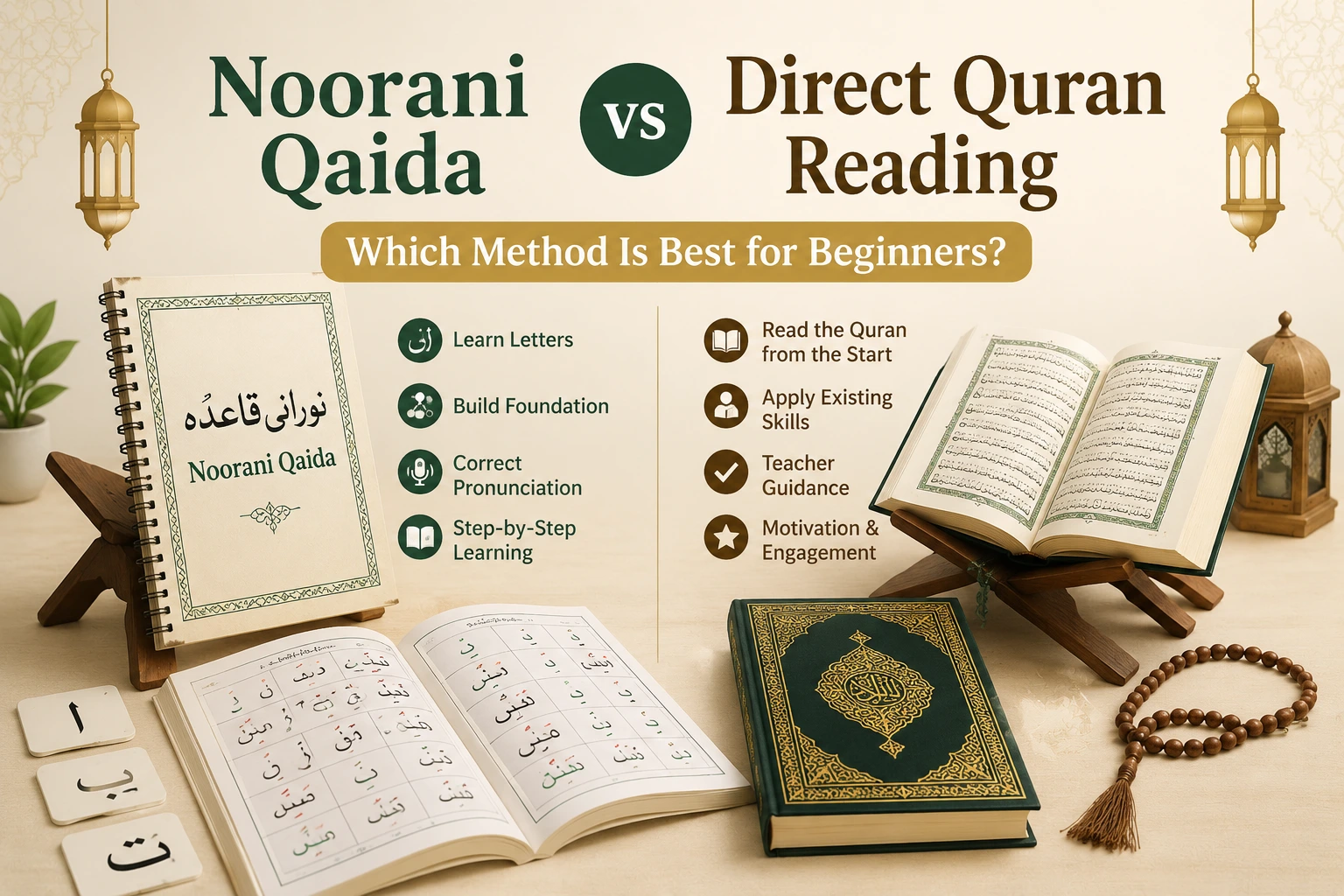
Should a complete beginner start with Noorani Qaida or begin reading directly from the Quran? The short answer is that there is no single method that is automatically best for every learner.
For many complete beginners who are unfamiliar with Arabic letters, a structured primer like Noorani Qaida is a highly useful starting point. It provides a progressive foundation in letter recognition, basic pronunciation, and reading rules. However, direct Quran reading can be a practical option for learners who already recognize Arabic letters, can read connected words, and have a foundational grasp of Arabic phonetics.
Both approaches have their place, but they serve different learning needs. Understanding how each method works can help parents choose the best path for their child. Many families begin by finding an online Quran teacher for kids to guide this first step.
Which Method Should a Beginner Choose?
Choose a structured Qaida first if:
- You cannot recognize most Arabic letters.
- You struggle to distinguish similar-looking letters.
- You are unfamiliar with Arabic vowel signs (Harakat).
- You cannot yet join letters into basic words.
- You need systematic pronunciation practice from scratch.
- You are a young child beginning from zero.
Direct Quran reading may be reasonable if:
- You already recognize the Arabic alphabet securely.
- You can read connected Arabic words with some fluency.
- You have some prior Quran-reading experience.
- Your basic pronunciation is already reasonably sound.
- A qualified teacher can guide you and correct mistakes as you read directly from the Mushaf.
Method Comparison
| Factor | Noorani Qaida | Direct Quran Reading |
|---|---|---|
| Starting level | Complete beginners | Learners with some Arabic reading ability |
| Main purpose | Build reading foundations | Apply existing reading skills to Quranic text |
| Letter recognition | Taught systematically | Usually already required |
| Joining letters | Practiced progressively | Encountered directly in Quranic words |
| Pronunciation | Can be practiced step by step | Corrected while reading Quran |
| Best for | Learners starting from zero | Learners with an existing foundation |
| Teacher feedback | Highly useful | Highly useful |
What Noorani Qaida Actually Teaches
Different editions and teaching curricula can vary slightly, but common Qaida lessons typically introduce foundational reading concepts in a structured manner. It breaks down the mechanics of reading Arabic into manageable steps.
A typical progression includes:
- Arabic letters: Recognizing individual letters.
- Different letter forms: How letters look at the beginning, middle, and end of words.
- Joining letters: Connecting letters together.
- Short vowel signs (Harakat): Fatha, Kasra, and Damma.
- Tanween: Double vowel signs indicating an “n” sound.
- Sukoon: The absence of a vowel on a letter.
- Shaddah: Doubling a letter.
- Madd: Long vowels.
- Basic pronunciation practice: Helping learners articulate unfamiliar sounds.
- Introductory Tajweed concepts: Some basic rules of recitation.
A structured foundation can make the transition to Quran reading easier for many beginners because learners have already practiced letter recognition, joining, vowel signs, and basic pronunciation before attempting full verses.
Direct Quran Reading
Direct Quran reading can work effectively when the learner already has foundational Arabic reading ability. For example, a learner may already know the Arabic letters, connected letter forms, basic vowel signs, and common pronunciation patterns.
In that situation, reading directly from the Mushaf while receiving teacher correction can be a practical next step. The student learns to apply their existing knowledge to real Quranic text, gradually improving fluency and accuracy.
However, someone who cannot yet recognize letters or pronounce them reliably may benefit from a structured primer first. Jumping straight into the Quran without knowing how to join letters or read Harakat can lead to frustration and deeply ingrained reading errors.
What If I Already Know the Arabic Alphabet?
Recognizing the alphabet is only one part of reading. A learner may know the names of the letters (Alif, Ba, Ta…) but still struggle with joining letters, applying vowel signs, handling Sukoon and Shaddah, and pronouncing connected words fluently.
Therefore, the decision should be based on actual reading ability rather than simply whether the learner can recite the alphabet from memory. If you know the letters but cannot read a short, voweled Arabic word, a Qaida provides the necessary stepping stones.
When Can a Learner Move from Qaida to the Quran?
A learner may be ready to transition from a primer to direct Quran reading when they can reasonably:
- Recognize Arabic letters in their various connected forms.
- Join letters into words correctly.
- Read common vowel patterns without extreme difficulty.
- Handle basic signs such as Sukoon and Shaddah.
- Pronounce letters with reasonable accuracy.
- Read short connected words without constant prompting.
A qualified teacher can judge readiness more accurately than a fixed timetable. The time needed to complete a Qaida varies considerably. It depends on the learner’s age, starting level, lesson frequency, practice at home, and ability to recognize and pronounce Arabic letters correctly. Some learners progress quickly, while others need considerably longer to build a solid foundation.
Tajweed Accuracy and Makharij (Articulation)
Noorani Qaida can introduce learners to foundational pronunciation and some basic Tajweed concepts, but proper Tajweed development requires guided practice and correction. Completing a Qaida does not automatically mean a learner has mastered Tajweed.
Arabic contains sounds whose articulation (Makharij) can be unfamiliar to speakers of many languages. For instance, some Arabic sounds (such as ع, غ, خ, ص, ض) have no direct equivalent in English and may require specific articulation practice. A book alone cannot correct pronunciation; a teacher’s ear is essential to guide the student toward accurate recitation.
Quran Reading for Children
For many young beginners, a structured Qaida can provide a manageable starting point. However, age alone should not determine the method; a child’s Arabic-letter recognition, pronunciation, attention span, and previous exposure to Quran reading matter more.
Consistent practice with a teacher who assesses the child’s readiness is key. Some children grasp the concepts rapidly, while others benefit from taking their time to secure each foundational step without feeling rushed into reading from the Mushaf.
Is Noorani Qaida Only for Children?
Adults and new Muslims can also use a structured Qaida if they are beginning from the basics. The fundamentals of reading Arabic are the same regardless of age. If an adult already reads Arabic confidently, they may need targeted Tajweed or Quran-reading instruction rather than starting from the very beginning. Again, a teacher’s assessment should guide the decision.
A Practical Beginner’s Path
Whether you are a parent guiding a child or an adult starting your own journey, a logical progression is helpful:
- Assess Arabic-letter recognition: Can the learner identify letters in isolation?
- Assess ability to join letters: Can they read basic connected words?
- Choose the right starting point: Select a Qaida or direct Quran reading based on the learner’s actual level.
- Practice consistently: Regular sessions with teacher correction yield the best results.
- Transition to the Quran: Move to the Mushaf when foundational skills are secure.
- Continue developing Tajweed: Refine pronunciation and rules while reading the Quran.
Learn with Quran Mentors
Having a qualified teacher to assess your level and guide your progress is invaluable. Whether you need to build a foundation or are ready to read directly from the Mushaf, structured online classes can provide the necessary feedback and correction.
You can explore learning options at Quran Mentors to find a suitable teacher for your needs. If you are looking for structured guidance from the beginning, you can learn Noorani Qaida online through their guided program.
Final Thoughts
For many complete beginners, especially those who are unfamiliar with Arabic letters and basic reading rules, a structured Qaida can provide a useful foundation before reading directly from the Quran. Learners who already have a solid Arabic reading foundation may be able to begin Quran reading sooner. The most suitable starting point depends on the learner’s current ability, and qualified teacher feedback can help determine the right path.
Frequently Asked Questions (FAQ)
1. Should I learn Noorani Qaida before reading the Quran?
If you are a complete beginner who cannot recognize Arabic letters or join them into words, a structured Qaida provides a very helpful foundation. If you already have strong Arabic reading skills, it may not be necessary.
2. Can I start reading the Quran without Noorani Qaida?
Yes, it is possible if you already possess the foundational skills to read connected Arabic text and apply basic vowel signs. However, for those starting from zero, jumping straight into the Quran can be very difficult without step-by-step preparation.
3. Is Noorani Qaida necessary for children?
It is a commonly useful teaching approach rather than a strict religious requirement. For most children starting from zero, it offers a manageable, progressive way to learn reading mechanics before handling the full Quranic text.
4. How long does it take to complete Noorani Qaida?
The timeframe varies considerably. It depends on the learner’s age, starting level, lesson frequency, home practice, and ability to grasp Arabic phonetics.
5. Is Noorani Qaida the same as learning Tajweed?
No. While a Qaida introduces basic pronunciation and some Tajweed concepts, proper Tajweed involves detailed rules of recitation that require ongoing guided practice and correction from a qualified teacher.
6. What if I already know the Arabic alphabet?
Knowing letter names is only the first step. You must also know how to join letters, apply short vowels, and pronounce connected words. If you struggle with these aspects, a structured Qaida may still be a useful next step.
7. When should a child move from Qaida to Quran reading?
A child is generally ready when they can recognize connected letters, read basic vowel patterns, handle signs like Sukoon and Shaddah, and read short words without constant prompting. A teacher’s assessment is the best indicator.
8. Can adults learn Noorani Qaida?
Absolutely. Adults and new Muslims beginning their Quranic journey from zero can benefit from the structured, foundational approach of a Qaida.
Continue Learning About Surah Fatiha
Surah Fatiha
Read Surah Al-Fatiha with Arabic text and translations.
Tafsir of Surah Fatiha
Explore verse-by-verse explanations and classical tafsir references.
Hadith About Surah Fatiha
Read authentic narrations about the status and role of Surah Al-Fatiha.
Benefits of Surah Fatiha
Explore benefits and virtues supported by Quran and authentic Hadith.