Reciting Al-Fatiha in the Haram: Praying Where the Qibla Points
Every Muslim recites Surah Al-Fatiha at least seventeen times a day. It is the one part of the Quran nobody forgets, learned in childhood and repeated in every single rak’ah for the rest of a person’s life. Which is exactly why, for most of us, it can slip by without much thought. The words come out while the mind is somewhere else entirely, on work or the school run or whatever is waiting after the prayer ends.
Then some people find themselves reciting it in Masjid al-Haram, facing the Kaaba itself, and something shifts. Pilgrims comparing Umrah packages all-inclusive of flights and hotels tend to think about the rites, the crowds and the cost. Very few think beforehand about what it will feel like to say these familiar seven verses in that particular place. Almost all of them mention it afterwards.
The direction you have faced your whole life
Wherever a Muslim prays, they turn towards the Kaaba. In Britain that means working out roughly south-east, checking an app, or following the lines marked on a mosque carpet. It becomes so routine that you stop thinking about what is at the other end of it.
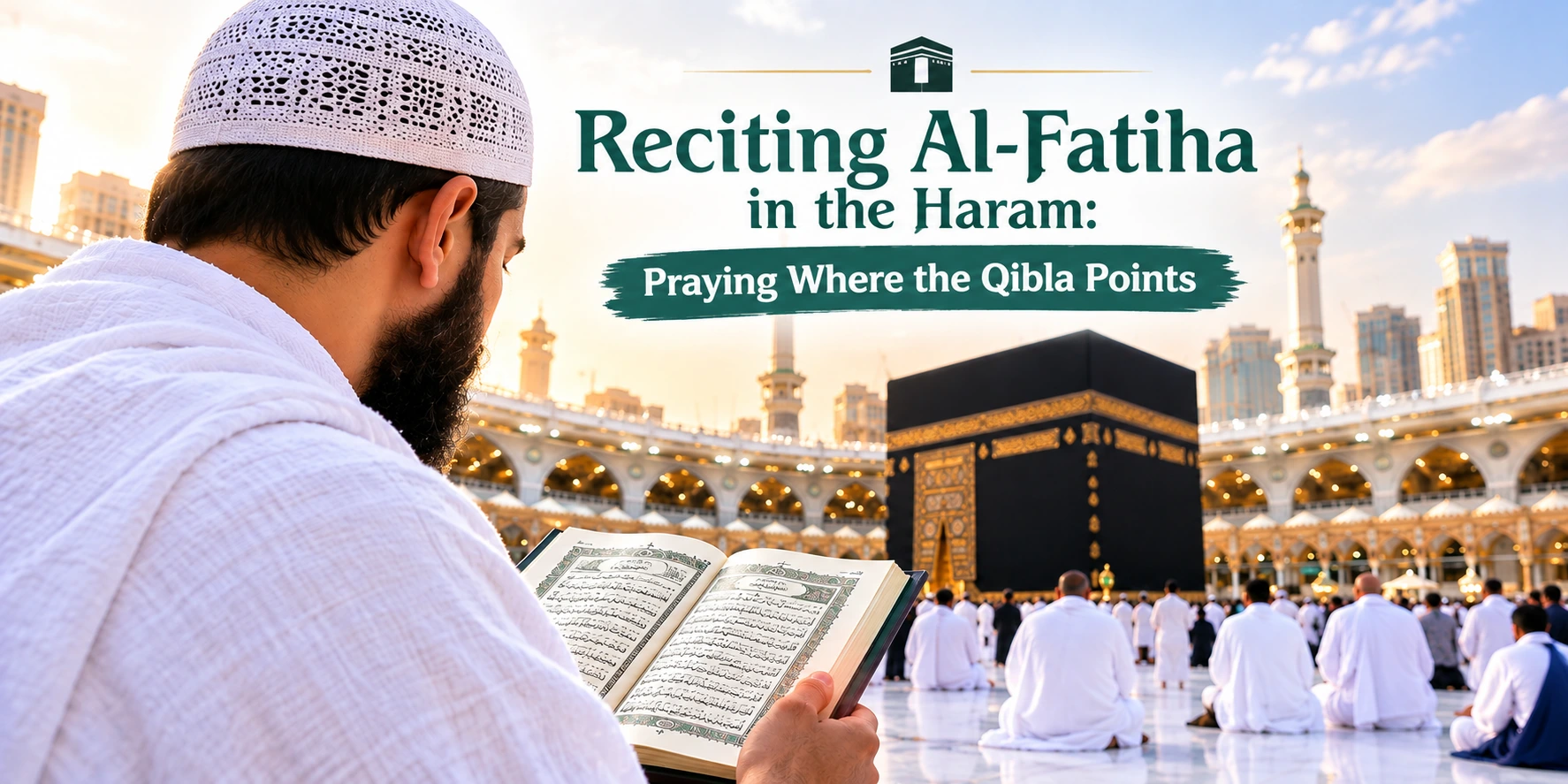
In the Grand Mosque there is nothing to work out. The Kaaba is directly in front of you. The direction you have faced for years, in bedrooms and offices and airport prayer rooms, is simply there. Pilgrims describe standing for the opening takbir and realising that the abstraction they have lived with all their lives is now a physical thing a few dozen metres away. The same surah, the same words, and an entirely different weight behind them.
Asking for guidance in that place
The structure of Al-Fatiha makes this even sharper. The surah does not open with a request. It opens with praise, moves to a statement of worship and dependence, and only then asks for something: to be guided along the straight path, the path of those favoured rather than those who went astray.
Making that request while standing in front of the Kaaba is an experience pilgrims struggle to put into words. Many say it is the first time they have really heard what they were saying. The asking becomes deliberate rather than automatic, and the surah stops being something recited and becomes something meant.
Behind the imams of the Haram
There is also the recitation itself. Praying in congregation in Makkah and Madinah means standing behind imams whose voices many Muslims have listened to for years on recordings, the same reciters people put on in the car or use to learn pronunciation at home.
Hearing that recitation live, with hundreds of thousands of people standing in rows behind you, is quite different from hearing it through headphones. Pilgrims often say they could not follow every word, and that it did not matter. What stayed with them was the sound of Al-Fatiha filling that space, and the moment when the whole congregation says Ameen together.
It is worth remembering what is reported in hadith about the reward for prayer in the two sacred mosques, which is multiplied many times over what it would be elsewhere. That is one reason pilgrims try to pray every obligatory prayer in the mosque itself rather than at the hotel, and why staying close to the Haram matters so much in practice.
Choosing when to go
If the aim is to pray with real attention rather than simply to survive the crowds, timing deserves thought. Ramadan carries the greatest reward and draws the largest numbers, and pilgrims who go then should expect long waits and very dense crowds, particularly in the last ten nights.
Families who want a calmer experience often travel outside those peaks, and school holidays shape the choice for anyone with children. This is why Easter Umrah Packages are popular with British families: the spring break falls after Ramadan and Eid have passed, the weather in Makkah is still mild, and the mosque is far less crowded than it is a few weeks earlier. Operators such as Islamic Travel Agency arrange those trips from the UK, and booking a hotel close to the mosque is the single decision that most affects how many prayers you actually manage there.
Madinah, and a quieter kind of prayer
Most pilgrims also spend a few days in Madinah, and they usually describe the prayers there differently. The Prophet’s Mosque is calmer, the courtyards are open and shaded, and there is time to sit between prayers rather than move constantly with the crowd.
People often say this is where the reflection they expected in Makkah finally arrives. The intensity of the rites is behind them, the pace drops, and reciting Al-Fatiha in that mosque feels unhurried in a way it rarely does at the Haram during a busy season.
What comes home with you
The part pilgrims do not anticipate is what happens afterwards. You return to the same prayer mat in the same room in Britain, facing the same direction as before. But having stood in front of the Kaaba, the direction means something different. Several people describe catching themselves during Fajr weeks later, suddenly picturing exactly what lies at the end of that line.
That is perhaps the most lasting thing a pilgrimage gives an ordinary worshipper. Not the photographs or the dates brought back for neighbours, but a small permanent change in a prayer said seventeen times a day. The surah is the same one you have always recited. You simply hear it properly now.
Author bio
This article was contributed in partnership with Islamic Travel Agency, a UK-based Hajj and Umrah travel operator. It is general information; for rulings on worship, consult a qualified scholar.